
Indonesia is accelerating the energy transition to cut carbon emissions, strengthen energy security, and reduce dependence on fossil fuels, aiming to achieve Net Zero Emissions (NZE) by 2060. A key part of accelerating the energy transition is regulation and policy; the Indonesian government issued the Second Nationally Determined Contribution (SNDC) in December 2025 to update climate targets with a more ambitious approach. Through three new scenarios, CPOS (Current Policy Scenario) which focuses on domestic action, and two Low Carbon Compatible With Paris Agreement scenarios (LCCP_Low and LCCP_High) which combine domestic action and international support to achieve the 1.5 ℃ pathway. In the SNDC document, the government, through the Ministry of Environment, changed the emission reduction target from a business-as-usual scheme to an absolute emission target whose value is below the LCCP (Low Carbon Compatible with Paris Agreement), namely 1,257,717 Gg CO2e (LCCP_L) and 1,488,866 Gg CO2e (LCCP_H). LCCP_L is a low-carbon development scenario that is in line with the Paris Agreement targets assuming a moderate or slower economic growth rate, while LCCP_H is a low-carbon development scenario that is in line with the Paris Agreement targets assuming a high economic growth rate.
One of the programs to accelerate the energy transition is through cofiring at coal-fired power plants using biomass. Co-firing will be implemented in phases, with a target of 3.2 million metric tons by 2025, which will gradually increase to 10.2 million metric tons by 2030. PT PLN EPI reports that it has supplied approximately 2.35 million metric tons of biomass for the co-firing program at coal-fired power plants in 2025; this volume is projected to increase to 3.65 million metric tons in 2026 and 4.07 million metric tons in 2027. Cumulatively over the 2023–2026 period, biomass supply has reached 4.77 million metric tons, with sawdust accounting for the largest share at 54.6% and wood chips at 22.4%.
All of this implies an increase in wood pellet production to meet cofiring needs. The government, through the Ministry of Environment and Forestry (which, after October 2024, will be split into the Ministry of Forestry and the Ministry of Environment), aims to develop Energy Plantation Forests by Industrial Plantation Forest companies covering an area of 1.29 million hectares to meet wood biomass needs. FWIs spatial analysis indicates that the area of energy plantations in 2026 will be 1.82 million hectares, involving a total of 49 companies. Deforestation occurring within energy plantations during the 2021–2025 period reached 53,450 hectares.
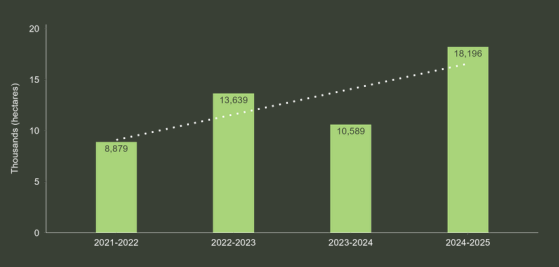
This ongoing deforestation is inconsistent with Indonesias commitments to many of the targets of the Kunming-Montreal Global Biodiversity Framework (KMGBF), which have also been adopted into the IBSAP document. One of these is the KM-GBFʼs 30×30 target (translated into National Target 3: “Achieving effective protection and management of protected areas and areas of high biodiversity value in terrestrial and aquatic ecosystems”). Currently, many Energy Plantation Concessions (EPC) are located within the habitats of flagship species such as the Sumatran rhinoceros, tiger, Sumatran orangutan, proboscis monkey, and lowland anoa. In addition to overlapping with the habitats of these flagship species, there are EPC that overlap with Key Biodiversity Areas covering 182,000 hectares. In fact, 148,000 hectares of these EPC fall into the category of high species richness. This further highlights Indonesiaʼs inconsistency in its commitment to the KMGBF.
Full details can be downloaded at the link below: