
Gorontalo Province, located in the Wallacea biodiversity hotspot on the island of Sulawesi, Indonesia, is increasingly becoming a centre of industrial woody biomass production. Driven by domestic energy policies and growing international demand for wood pellets, particularly from Japan and South Korea, the expansion of energy plantation forests (Hutan Tanaman Energi, HTE) is placing increasing pressure on natural forests, biodiversity, ecosystem services, and the rights and livelihoods of Indigenous Peoples and Local Communities (IPLCs).
This report challenges the assumption that industrial large-scale woody biomass is inherently a climate-friendly energy source, highlighting how the conversion of natural forests into monoculture plantations can undermine climate mitigation objectives while generating significant ecological and social costs.
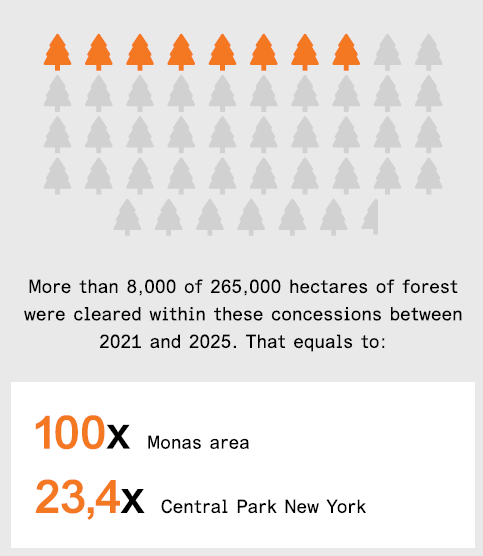
There are ten energy plantation concessions in Gorontalo, covering more than 265,000 hectares. Trend Asia’s latest analysis of four of them, operated by PT Banyan Tumbuh Lestari (BTL), PT Inti Global Laksana (IGL), PT Gorontalo Citra Lestari (GCL), dan PT Gema Nusantara Jaya (GNJ), found 9,617 hectares of deforestation between 2020 and 2026, while 44,685 hectares of forests still standing inside these concessions remain at risk. The scale of forest conversion is particularly evident in the concession of PT BTL, which has lost 42% of the forest it contained in 2020, and where satellite imagery analysis by Auriga Nusantara identified approximately 720 hectares of deforestation between January and April 2026 alone. Field investigations indicate that wood harvested from these PT IGL and BTL is processed at the PT Biomasa Jaya Abadi pellet mill in Pohuwato Regency, which supplies Japanese trading company Hanwa, illustrating the connection between forest conversion and industrial biomass production.
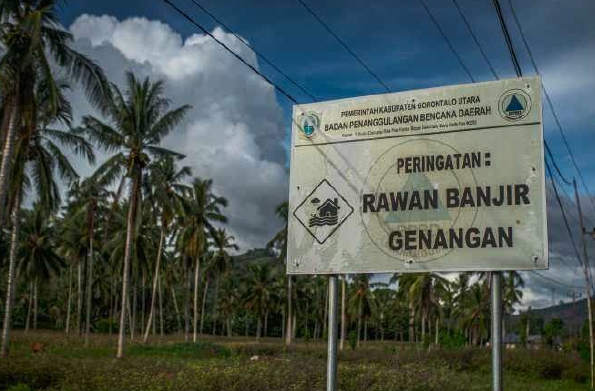
The consequences extend beyond forest loss. Gorontalo’s tropical moist forests provide critical habitat for endemic and threatened species, support watershed functions, store carbon, and sustain local livelihoods and cultural identities. Energy plantation concessions overlap around 75,412 hectares of Key Biodiversity Areas, 59,623 hectares of Important Bird Areas, and forests used by the Indigenous Polahi People, raising concerns about habitat fragmentation, ecosystem degradation, and the long-term resilience of these landscapes. In Pohuwato, residents who demanded unfulfilled benefit-sharing obligations have reportedly been detained and criminalised, raising questions about the implementation of Free, Prior and Informed Consent (FPIC) and the equitable distribution of benefit from the energy transition.
These impacts expose significant weaknesses in existing governance and sustainability safeguards. Indonesia’s Timber Legality and Sustainability Verification System (SVLK) does not prevent natural forest conversion that is permitted under a concession’s work plan or that takes place on land outside state forest estate. Voluntary certification schemes, such as the Forest Stewardship Council (FSC) and the Sustainable Biomass Program (SBP), also face concerns regarding transparency, implementation, and their ability to address cumulative forest conversion, biodiversity loss, and Indigenous rights. The concession of PT Gema Nusantara Jaya, FSC-certified in 2017-2021 and again in 2024, lost 1,592 hectares of forest between 2020 and 2026, raising questions about whether sustainability certification adequately captures forest loss and community-related risks.
International demand remains an important driver of biomass production in Indonesia. Japan and South Korea continue to support woody biomass through energy policies, market mechanisms, and, historically, substantial subsidies. Both countries have introduced reforms, but neither has established a comprehensive phase-out of large-scale biomass or a due diligence framework that addresses deforestation, ecosystem conversion, lifecycle emissions, and human rights risks across imported biomass supply chains.
The climate implications are particularly significant. Because carbon dioxide released through biomass combustion is not counted in the energy sector, biomass can appear carbon-neutral while the loss of carbon stored in natural forests goes largely unaccounted for.
The evidence from Gorontalo demonstrates the need to reconsider the role of large-scale woody biomass in energy transition strategies. A credible transition must deliver measurable climate benefits without accelerating deforestation, undermining biodiversity, or compromising the rights of IPLCs.
Responsibility for what is happening in Gorontalo is shared along the entire supply chain. Japan and South Korea, whose subsidies and import demand drive this expansion, should phase out public support for large-scale woody biomass and make deforestation-free, rights-respecting sourcing a binding condition for imported biomass. Power utilities, trading companies such as Hanwa, and the banks and investors that finance them should stop sourcing from converted natural forests and carry out due diligence that engages directly with affected communities. Certification schemes such as FSC and SBP should enforce their own rules on forest conversion rather than lend it credibility. Indonesia, for its part, should legally protect all remaining natural forests, close the loopholes in SVLK, and uphold community rights, including FPIC. In both producer and consumer countries, the energy transition should prioritise energy efficiency, electrification, solar, and wind alongside the protection and restoration of natural ecosystems.